So, continuing from where I left off on the latest draft of the rules (which can be found here if you need a link). I spend a good while rambling about why I decided to make Fighting Styles and Backgrounds in place of regular Traits. Well, I mostly talked about Fighting Styles but the division of non-combat Traits into Backgrounds was pretty darn helpful too.
First and foremost, I decided that I didn't need as many Traits as before. In different versions I've shuffled between 5 to 6 Traits of varying intensity, now we've got 4 (including the default Fighting Style everyone starts with) but I'm encouraging bigger and broader Backgrounds in place of more traditional Traits. No-one should have a Trait like "tracking prey" or "picking locks"...we're looking at Traits that are more like entire character concepts in miniature, like "Under-King Of the Mole People" or a cyborg who is a "Walking Swiss Army Knife". Since Backgrounds have been made explicitly non-combat, that gives more freedom without having to worry about whether or not it balances with a combat Trait or whether or the crossover with an ability that has utility in both a Clash and a non-combat situation.
That also helped me to resolve a particular niggle involving magical combat. Having hyper-powered wizards, psychics, nano-warlocks or other wielders of vast cosmic powers was always part of the goal for the system. But by their nature those powers imply a variety of combat and non-combat utility. The division between Backgrounds and Fighting Style means that such characters would take an Arcane Fighting Style to represent their ability to tear things up and separate Backgrounds to represent the stuff they can pull off when they aren't tearing things up.
Knacks
Knacks and Styles were never a huge factor in the system, but when working on this draft I realized just how annoying it is to change even a relatively small thing. I had just finished working on the draft, needing only to give it a bit of cleaning up to get things like page markers pointing the right way, when I had a mini-epiphany. It happened just as I was falling asleep too and so I had to go downstairs and write it down before it got lost...then I had to go through the whole friggin document and adjust so much little stuff to match it.
Knacks are a pretty familiar concept from other games...PDQ has Techniques which serve a similar role, White Wolf games have specialties and I bet with a bit more thought I could think up another dozen or so examples. Basically a little "bump" when using an ability in a particular way. Want to be a good swordfighter but be even better as a one-on-one duelist...take a Knack for it. Bam, done. Styles were inspired by PDQ's "unchained" techniques, basically the same thing but applying globally to a character's abilities. Styles are a great way to represent little advantages (like a lucky hat) or idiomatic quirks of a character (such as making them better at everything when not wearing a shirt).
Well, as I was thinking about the system that night I began to ponder if there were just too many bonuses in the game. I like the core system, but I also recognize that no one wants a dice pool system where you've got to roll buckets of dice...especially if you're already using different die-types. Anything calling for more than a handful of d8s or d12s is a problem, if not necessarily a disaster. So I start to ponder places the fat could be trimmed. Obviously 2 dice needs to be the minimum, 1 die is just too random. Bonuses from things like Powers or boosts from Strikes need to be significant to remain balanced with other options so they've got to stay and I'm far, far too enamored with the Fighting Spirit rules to ditch those. That kind of left Knacks and Styles, which are also the reason that most characters are going to be rolling 3-5 dice at minimum anyway, since it's easy to invest in a couple of reliable Knacks and your Style is meant to apply at almost all times anyway.
But I really liked knacks and styles, Styles especially because I think it's important to be able to say "my character gets a bonus to everything when they're drunk/covered in blood/being the loudest in the room". But then some gears snapped into place and started turning and I came to my current solution...basically merging the two. Rather than a selection of Knacks and a single Style, now everyone just has two Knacks that operate much like Styles did...providing a global bonus to all rolls when acting in line with the Style. To keep bonuses from climbing too high they don't stack (this also means buying up tons of cheap Knacks won't be incentivized) and it gets rid of the issue with whether to invest Knacks into Fighting Styles or Backgrounds (because, being honest, they're a lot more useful in fighting styles).
Well, I liked the idea but that meant I had to go through the entire document getting rid of every reference to styles, reformatting all the example characters and generally nitpicking to try and fix this one little rule.
That's probably enough whining about that, so I'll go ahead and post more about the other changes later.

Showing posts with label rpgs. Show all posts
Showing posts with label rpgs. Show all posts
Monday, April 2, 2018


Sunday, December 27, 2015
Almost two years...
Been a while hasn't it? Last couple of years have been...rough to say the least. Sadly the fact that I'm popping up here doesn't mean everything is better now. I'd say that there's some hopeful developments but it seems like every time I express any optimism some new horrible thing happens.
But I'll try to avoid getting too deep into that. I've returned (I say like anyone really notices the absence) because despite the trials of the last few years I've still had the chance to work on some RPG projects and several of them are coming along quite well. Sadly I haven't had the chance for any actual gaming in the past 6 months or so and this serves as a kind of vicarious gaming experience for me.
So, with a bit of extra free time at the moment I figured I'd start posting here again, hoping to keep the project's momentum going. Theoretically this will be a kind of "development blog"...except I'm already approaching the final draft on these games. But I do think typing out my thoughts and reasoning might help me get those last few pieces in place.
So, what have I been doing with myself?
Well, first and foremost a couple of entries in the "RPG Chopshop" category.
Dark Sun/Savage Worlds: I know what you're thinking, "didn't you do this already?". Yes, I did already have an entry on my Athasian conversion for Savage Worlds, but since then I've had a chance to refine and expand the conversion a bit. The final product is a 29 page PDF available here: Savage Dark Sun. In addition to serving as a setting document for Dark Sun it also includes some Edges that'll be generally useful for any Savage Worlds fantasy game, including some Legendary Edges I'm quite proud of.
Shadowrun/Savage Worlds: During the time of silence I ran (or started to run...sadly it got interrupted) a game of Shadowrun with my main gaming group. Not being a fan of the normal Shadowrun system I decided this also needed to be run in Savage Worlds. However, most Savage Worlds cyberpunk games out there don't properly scratch my itch, so I decided to make my own. The result is a much more ambitious 96 page conversion (with nifty custom character sheets): Savage Shadowrun. This is kind of my personal take on the Shadowrun universe, cherry-picking different setting elements (wireless and AR exist, but VR is much better, older-style Shaman vs Mage casting dichotomy, etc) and including a more in-depth character creation mechanic (using Shadowrun's Priority concept) and a bit of blatant gear-porn.
PDQ Scion: Finally, we've got a quicker and dirtier 10 page conversion of Scion to the PDQ system: PDQ Scion The system is based on Truth and Justice with some of my own modifications based on my work with the PDQ edition of Acthung! Cthulhu.
But what I really want to talk about are my original games, especially a new one that hasn't yet appeared on this blog at all. I'll get into those with my next post which will, hopefully, not be another two years from now.
Wednesday, December 4, 2013
Character Gallery I: The Iron Chaplain
So, just a random idea. I'd like to update more often but I'm often short on time and/or dry on ideas. What I can generally count on is coming up with lots and lots of ideas for NPC and PC characters for games I may or may not ever run. So, I figure starting up a semi-regular posting of random characters I have used or will in the future. Since they're my favorite systems you can probably expect a lot of Savage Worlds and PDQ characters but I promise I'll try and mix it up.
The Iron Chaplain
The Iron Chaplain is a warforged battle-cleric from my Eberron campaign, the War of the Forge. He was a well known war-hero of Thrane during the Last War, and a cleric of the Silver Flame. However, after the war he became disillusioned by the treatment warforged received in Thrane and left the country. He has reappeared as one of the Lord of Blade's trusted lieutenant's and one of the spiritual leaders of the Mournlands warforged. Like most of the warforged followers of the Lord Of Blades he has taken a "weapon name" and now goes by "Morningstar"
Although devoted to the cause of the Lord of Blades the Iron Chaplain is still a fairly noble soul, a believer in mercy and loyalty. He is a strict follower of the "laws of war" and when he takes the battlefield he fights fairly and treats prisoners and civilians with respect. He is often a voice of reason and temperance among the more bloodthirsty warforged who surround the Lord of Blades.
When I introduced the Chaplain I had converted Eberron to Savage Worlds, so here are his Savaged Stats:
The Iron Chaplain
The Iron Chaplain is a warforged battle-cleric from my Eberron campaign, the War of the Forge. He was a well known war-hero of Thrane during the Last War, and a cleric of the Silver Flame. However, after the war he became disillusioned by the treatment warforged received in Thrane and left the country. He has reappeared as one of the Lord of Blade's trusted lieutenant's and one of the spiritual leaders of the Mournlands warforged. Like most of the warforged followers of the Lord Of Blades he has taken a "weapon name" and now goes by "Morningstar"
Although devoted to the cause of the Lord of Blades the Iron Chaplain is still a fairly noble soul, a believer in mercy and loyalty. He is a strict follower of the "laws of war" and when he takes the battlefield he fights fairly and treats prisoners and civilians with respect. He is often a voice of reason and temperance among the more bloodthirsty warforged who surround the Lord of Blades.
When I introduced the Chaplain I had converted Eberron to Savage Worlds, so here are his Savaged Stats:
Agility-d6, Smarts-d6, Spirit-d12, Strength-d10, Vigor-d10
Skills: Fighting-d12, Notice-d6, Faith-d12, Knowledge (Battle) d8
Pace: 6”, Parry:8, Toughness: 11 (4)
Edges: Nerves of Steel, Charismatic
*Enchanted Mithril Plating +4 armor, grants Arcane Resistance
*Enchanted greatmace (1d10+1d8+2) 2 AP vs rigid armor
*Powers: 35 PP. Powers: Boost Trait, Armor, Blade Barrier (damaging barrier), Dispel, Mending, Smite, Stun, Summon Ally (Sentinel), Divine Power (boosts Vigor and Spirit and acts as 4 levels of Growth. 12 power points to cast).
Sunday, November 10, 2013
CARDS RPG: The Mage
Wow, it's been a long time. So long I'm needing to re-read these mechanics as a write them to make sure that I haven't forgotten how this game was meant to be played. Here's the Mage and hopefully the rest of it will be completed soon.
Okay, so now we're on to the mage, and this brings up something I've been struggling with: How does magic work in CARDS? There are tons of different magic systems out there and they all have different things they bring to the table. Personally I always find myself torn between magic systems with unique, iconic spells (D&D and Exalted are good examples) and ones that allow a great deal of flexibility and freedom (QMR or Mage for instance). But, I've also got to keep in mind that this system is fairly simple and I should be aware of it's limits. I also don't want spellcasters to be significantly more complex than the other classes. A complex magic system typically means that a mage is either less fun or effective than other classes or, with enough mastery of the system, significantly more effective.
So in the end, I'll probably take my cues from FATE, especially the Dresden Files RPG. Essentially, magic is not significantly different than anything else. A mage can attack, defend, and perform Tasks just like a normal character. If it's possible to achieve the same effects without magic then it's possible to do it with magic and if it's impossible without magic then magic can't be used to get around it (excepting through the use of Tricks). So, if faced with a locked door a mage could play a Clubs card to blast it open, or a Spades to charm the lock, and the target number would be the same as if they were a warrior or trickster. However, without an appropriate Trick the mage cannot simply walk through the door like a ghost. Mages can typically ignore the need for tools like weapons or lockpicks, but they do have to wave their hands and chant their magic words.
Magic can be used for ranged attacks (see the rules on range here), in the form of magic bolts and so on. If a mage is attempting to keep a spell "running" for longer than a single Task or action in a Struggle then they have to take an action and playing a new card every turn (effectively "repeating" the spell round by round) in a Struggle, or every 15 out-of-games minutes. The new card played becomes the Card Value of the spell for that turn, or for the next 15 minutes. That sounds a bit awkward so let me give an example.
Mike The Mage is in a Struggle. While his friends are attempting to defeat a golem guarding the king's treasure the Royal Guard have been alerting and are trying to break into the treasure room. On his action, Mike gestures and causes the doors to swing shut and seals them with an arcane rune of binding (this is a Clubs action, effectively holding the door closed with brute force) Mike plays a 9 of Clubs, so the guards will have to beat a 9 in order to break down the door, which they fail to do. Next turn Mike wants to keep the spell running to keep them from breaking through, He has to play another card, dropping a 6 of Clubs. This means the guards now have to beat only a 6 when they attempt to break in this turn.
Magic definitely can not instantly slay, paralyze, knock out, or mind control opponents. Certainly such spells exist but they work using the normal Struggle system for damage. A death spell is not effectively any different from a lightning bolt.
So, that's a lot of words that boil down to "magic works pretty much the same as non-magic, it just looks neater". The real difference comes in the form of Tricks. The Warrior is all about power, when they succeed they succeed impressively. The Trickster is all about reliability, they will succeed more often than not which makes them very good at defense and tackling Tasks. Mages are all about flexibility and expanded options.They can do things in ways other classes cannot and to a degree that is normally impossible, however they don't get much in the way of flat bonuses so their successes to be less impressive. The Mage's two Trick categories are Spells (-; granting a specific special power) or Enhancements (+, altering how an effect is pulled off or who it affects).
Starting Tricks:
*Magic Resistance: When attempting to resist or overcome a magical effect, the Mage gets a +2 bonus to their Card Value.
*Magic Tricks: Remember how I said that magic works the same as non-magic, just looks neater. Well, that's true in most cases, but sometimes the flexibility of magic gives it a distinct advantage. For instance, a mage's fire-bolt could set fire to a house or severely injure an ice-beast, while an archer's arrow would not. When you want to add some kind of advantageous special effect to a magical action then you must discard a card. You can also discard a card to perform minor, but useful, magic tricks (such as lighting every candle in a room as you enter). Minor, but not useful, tricks shouldn't involve any extra cost (making your nose a bit longer or emitting spectral flatulence).
*Magic Dependent: Magic is a powerful tool, but it demands a lot of it's practicioners, meaning that they're generally not as capable without it. When in a situation where you're attempting to deal with a situation without resorting to magic you suffer a -2 penalty to the Card Value of your actions. If your game is going to involve lots of situations where magic can be suppressed or persecuted then this penalty should probably be dropped to -1, or increased to -3 if the opposite is true.
Mage Tricks:
1st Level
-Evil Eye: A curse of misfortune and grief. The victim suffers countless minor indignities and bad luck and a -1 to all Card Values. This lasts 24 hours and does not need to be maintained. This is a Diamonds action, resisted by Hearts.
or
+Far Spell: By discarding a card when making an attack you can increase your range, suffering no penalty for attacking Far Away targets and attacking targets at a longer range (that you can see and directly target) with Difficulty.
2nd Level
-Telekinesis: This Trick allows you to do anything that could be done by hand a distance (Close range normally, Far Away it becomes difficult). You can cause a sword to swing, open a door, shove a foe, etc.
or
+Power Up: By taking additional time to build up your magical energy you may unleash spells of immense power. You may play one card per turn (or cards if the action is Difficult), keeping all cards in play until you choose to unleash your spell, adding all the cards together to get the final Card Value. The cards must be of the same suit and it is not possible to "hold" a spell, it must be unleashed as soon as you're done charging up.
3rd Level
-Counterspell: Diamonds becomes an appropriate suit for defending yourself against magical attacks, and you may attempt to dispel or break enduring enchantments as a Task.
or
+Focus: Maintaining your spells is easier. Rather than having to repeat the same action turn by turn you may discard a card at the start of your turn to keep the previous card "in play" for another round. This does not require an action.
4th Level
-Flight: You can take flight as a Spades action, flying at roughly the same speed you can run. The card used in your action serves as the maximum Card Value for any physical actions you take while in flight (such as attempting to dodge an attack or swing at someone else). This must be maintained as normal, if the spell lapses (as opposed to being dispelled in some way) then you float gently to the ground.
or
+Barrier: Discarding a Diamond card allows you to play a card to create a barrier. The barrier can be offensive (attacking anyone who passes through it) or defensive (resisting attempts to pass through) using it's Card Value. The barrier can be a simple wall (up to 10 yards or so wide) or a circle or dome (which may be big enough to encompass anyone within Close distance). This spell must be maintained like normal.
5th Level
-Drain Life: By discarding a Hearts and Diamond card before making an attack you may absorb your opponent's life force. For every point of damage inflicted, return a card from the top of your discard pile to the bottom of your deck.
or
+Blast: By discarding a Diamond or a Clubs card you may cause a spell to affect a large area, affecting everyone Close to the original target. This is not selective, all are affected equally.
6th Level
-Projection: As a Diamonds action you may project your senses at a distance (at normal range), ignoring barriers or other physical impediments. Your projection is completely intangible and is usually invisible and inaudible (unless you wish it to be otherwise). This spell may be maintained and if so you may move your projection at a swift walking speed each round.
or
+Chain Spell: You may discard a card to have one of your spells affect a second target (they get to play their own resistance card against your action, assuming it is negative). You may discard additional cards to affect more targets, but you cannot target the same character twice.
7th level
- Charm Item: enchantment enhances the ordinary function of an otherwise mundane item. Whatever the item's general function, it will perform better: swords will be sharper, bows more accurate, armor is more durable, etc. The wielder of the item receives a bonus to appropriate rolls for the remainder of the scene equal to half the value of the card used in the action (this is a Diamond Action). This cannot be maintained. None weapon charms will typically add a bonus to some related tasks with the approval of the DM (an enchanted pair of boots may add in leaping and running for instance).
or
+Sympathetic Magic: If you have access to some sort of mystical link to a target (typically this would be ritually prepared blood, hair, etc) then you may target them even if you cannot normally perceive them by discarding a Diamonds card. This transcends normal ranges and may affect anyone on the same world but it is always Difficult.
8th Level
-Teleportation: As a Diamonds action you may disappear and reappear somewhere else. The range is based on the TN set by the DM (generally 2-5 is within combat range (close to Far Away), 6-9 is within a handful of miles, 10+ would be for Teleporting between cities or countries), which may be increased if the Mage cannot see the target or envision it properly. It is possible to take additional willing targets with you so long as they're nearby and you discard a card for each additional character.
or
+Contingent Spell: You may play any card(s) you wish and state the spell they are intended for and a condition that will cause the spell to activate. When the condition is met then the spell will activate without requiring an action. If circumstances would cause the spell to be treated as Difficult then you may supply additional cards from your hand if possible...if not then the spell fails. The contingent spell will remain indefinitely until triggered.
9th Level
-Shapechange: By discarding a Hearts, Clubs and Spades card you may take a Diamonds action to transform into the shape of an animal, monster, or similar other form. The Card Value of your action can be used as the Card Value of any actions or reactions appropriate to the new form. For instance, taking the form of a giant would allow you to apply the Card Value of your spellcasting action to rolls to resist physical injury or feats of strength. Your abilities are limited to physical abilities possessed by the new shape...you might take the form of a demon but this grants you no infernal powers. This must be maintained as normal (obviously without the Focus Trick your new form will be quite unstable).
or
+Persistent Spell: Your spells are irresistible. When an opponent successfully resists a spell you may discard a Diamonds and Spades card in order to have the spell continue to "target" the victim. On the next turn (or 15 minutes of out of game time if you are not in a Struggle) the spell "repeats" at the same Card Value without requiring an action. This continues until the target fails to overcome the spell, the spell is somehow disrupted, or the caster chooses to cancel it. This does not require maintenance, although once the spell succeeds it must be maintained in order to continue functioning.
10th level
-Mage's Eye: The universe opens up to you. As a Diamonds action you may increase the maximum number of cards in your hand by half the Card Value of the action (rounding up). This must be maintained, and if the Card Value drops or the spell ends then you must discard any extra cards.
or
Permanence: By discarding a Diamonds and Hearts card when casting a spell you may choose to make the spell permanent. The action's card(s) are set aside and serve as the Card Value of the spell until it is destroyed or you intentionally cancel the magic (at which point they are discarded). If you attempt to create more than one Permanent enchantment
Okay, so now we're on to the mage, and this brings up something I've been struggling with: How does magic work in CARDS? There are tons of different magic systems out there and they all have different things they bring to the table. Personally I always find myself torn between magic systems with unique, iconic spells (D&D and Exalted are good examples) and ones that allow a great deal of flexibility and freedom (QMR or Mage for instance). But, I've also got to keep in mind that this system is fairly simple and I should be aware of it's limits. I also don't want spellcasters to be significantly more complex than the other classes. A complex magic system typically means that a mage is either less fun or effective than other classes or, with enough mastery of the system, significantly more effective.
So in the end, I'll probably take my cues from FATE, especially the Dresden Files RPG. Essentially, magic is not significantly different than anything else. A mage can attack, defend, and perform Tasks just like a normal character. If it's possible to achieve the same effects without magic then it's possible to do it with magic and if it's impossible without magic then magic can't be used to get around it (excepting through the use of Tricks). So, if faced with a locked door a mage could play a Clubs card to blast it open, or a Spades to charm the lock, and the target number would be the same as if they were a warrior or trickster. However, without an appropriate Trick the mage cannot simply walk through the door like a ghost. Mages can typically ignore the need for tools like weapons or lockpicks, but they do have to wave their hands and chant their magic words.
Magic can be used for ranged attacks (see the rules on range here), in the form of magic bolts and so on. If a mage is attempting to keep a spell "running" for longer than a single Task or action in a Struggle then they have to take an action and playing a new card every turn (effectively "repeating" the spell round by round) in a Struggle, or every 15 out-of-games minutes. The new card played becomes the Card Value of the spell for that turn, or for the next 15 minutes. That sounds a bit awkward so let me give an example.
Mike The Mage is in a Struggle. While his friends are attempting to defeat a golem guarding the king's treasure the Royal Guard have been alerting and are trying to break into the treasure room. On his action, Mike gestures and causes the doors to swing shut and seals them with an arcane rune of binding (this is a Clubs action, effectively holding the door closed with brute force) Mike plays a 9 of Clubs, so the guards will have to beat a 9 in order to break down the door, which they fail to do. Next turn Mike wants to keep the spell running to keep them from breaking through, He has to play another card, dropping a 6 of Clubs. This means the guards now have to beat only a 6 when they attempt to break in this turn.
Magic definitely can not instantly slay, paralyze, knock out, or mind control opponents. Certainly such spells exist but they work using the normal Struggle system for damage. A death spell is not effectively any different from a lightning bolt.
So, that's a lot of words that boil down to "magic works pretty much the same as non-magic, it just looks neater". The real difference comes in the form of Tricks. The Warrior is all about power, when they succeed they succeed impressively. The Trickster is all about reliability, they will succeed more often than not which makes them very good at defense and tackling Tasks. Mages are all about flexibility and expanded options.They can do things in ways other classes cannot and to a degree that is normally impossible, however they don't get much in the way of flat bonuses so their successes to be less impressive. The Mage's two Trick categories are Spells (-; granting a specific special power) or Enhancements (+, altering how an effect is pulled off or who it affects).
Starting Tricks:
*Magic Resistance: When attempting to resist or overcome a magical effect, the Mage gets a +2 bonus to their Card Value.
*Magic Tricks: Remember how I said that magic works the same as non-magic, just looks neater. Well, that's true in most cases, but sometimes the flexibility of magic gives it a distinct advantage. For instance, a mage's fire-bolt could set fire to a house or severely injure an ice-beast, while an archer's arrow would not. When you want to add some kind of advantageous special effect to a magical action then you must discard a card. You can also discard a card to perform minor, but useful, magic tricks (such as lighting every candle in a room as you enter). Minor, but not useful, tricks shouldn't involve any extra cost (making your nose a bit longer or emitting spectral flatulence).
*Magic Dependent: Magic is a powerful tool, but it demands a lot of it's practicioners, meaning that they're generally not as capable without it. When in a situation where you're attempting to deal with a situation without resorting to magic you suffer a -2 penalty to the Card Value of your actions. If your game is going to involve lots of situations where magic can be suppressed or persecuted then this penalty should probably be dropped to -1, or increased to -3 if the opposite is true.
Mage Tricks:
1st Level
-Evil Eye: A curse of misfortune and grief. The victim suffers countless minor indignities and bad luck and a -1 to all Card Values. This lasts 24 hours and does not need to be maintained. This is a Diamonds action, resisted by Hearts.
or
+Far Spell: By discarding a card when making an attack you can increase your range, suffering no penalty for attacking Far Away targets and attacking targets at a longer range (that you can see and directly target) with Difficulty.
2nd Level
-Telekinesis: This Trick allows you to do anything that could be done by hand a distance (Close range normally, Far Away it becomes difficult). You can cause a sword to swing, open a door, shove a foe, etc.
or
+Power Up: By taking additional time to build up your magical energy you may unleash spells of immense power. You may play one card per turn (or cards if the action is Difficult), keeping all cards in play until you choose to unleash your spell, adding all the cards together to get the final Card Value. The cards must be of the same suit and it is not possible to "hold" a spell, it must be unleashed as soon as you're done charging up.
3rd Level
-Counterspell: Diamonds becomes an appropriate suit for defending yourself against magical attacks, and you may attempt to dispel or break enduring enchantments as a Task.
or
+Focus: Maintaining your spells is easier. Rather than having to repeat the same action turn by turn you may discard a card at the start of your turn to keep the previous card "in play" for another round. This does not require an action.
4th Level
-Flight: You can take flight as a Spades action, flying at roughly the same speed you can run. The card used in your action serves as the maximum Card Value for any physical actions you take while in flight (such as attempting to dodge an attack or swing at someone else). This must be maintained as normal, if the spell lapses (as opposed to being dispelled in some way) then you float gently to the ground.
or
+Barrier: Discarding a Diamond card allows you to play a card to create a barrier. The barrier can be offensive (attacking anyone who passes through it) or defensive (resisting attempts to pass through) using it's Card Value. The barrier can be a simple wall (up to 10 yards or so wide) or a circle or dome (which may be big enough to encompass anyone within Close distance). This spell must be maintained like normal.
5th Level
-Drain Life: By discarding a Hearts and Diamond card before making an attack you may absorb your opponent's life force. For every point of damage inflicted, return a card from the top of your discard pile to the bottom of your deck.
or
+Blast: By discarding a Diamond or a Clubs card you may cause a spell to affect a large area, affecting everyone Close to the original target. This is not selective, all are affected equally.
6th Level
-Projection: As a Diamonds action you may project your senses at a distance (at normal range), ignoring barriers or other physical impediments. Your projection is completely intangible and is usually invisible and inaudible (unless you wish it to be otherwise). This spell may be maintained and if so you may move your projection at a swift walking speed each round.
or
+Chain Spell: You may discard a card to have one of your spells affect a second target (they get to play their own resistance card against your action, assuming it is negative). You may discard additional cards to affect more targets, but you cannot target the same character twice.
7th level
- Charm Item: enchantment enhances the ordinary function of an otherwise mundane item. Whatever the item's general function, it will perform better: swords will be sharper, bows more accurate, armor is more durable, etc. The wielder of the item receives a bonus to appropriate rolls for the remainder of the scene equal to half the value of the card used in the action (this is a Diamond Action). This cannot be maintained. None weapon charms will typically add a bonus to some related tasks with the approval of the DM (an enchanted pair of boots may add in leaping and running for instance).
or
+Sympathetic Magic: If you have access to some sort of mystical link to a target (typically this would be ritually prepared blood, hair, etc) then you may target them even if you cannot normally perceive them by discarding a Diamonds card. This transcends normal ranges and may affect anyone on the same world but it is always Difficult.
8th Level
-Teleportation: As a Diamonds action you may disappear and reappear somewhere else. The range is based on the TN set by the DM (generally 2-5 is within combat range (close to Far Away), 6-9 is within a handful of miles, 10+ would be for Teleporting between cities or countries), which may be increased if the Mage cannot see the target or envision it properly. It is possible to take additional willing targets with you so long as they're nearby and you discard a card for each additional character.
or
+Contingent Spell: You may play any card(s) you wish and state the spell they are intended for and a condition that will cause the spell to activate. When the condition is met then the spell will activate without requiring an action. If circumstances would cause the spell to be treated as Difficult then you may supply additional cards from your hand if possible...if not then the spell fails. The contingent spell will remain indefinitely until triggered.
9th Level
-Shapechange: By discarding a Hearts, Clubs and Spades card you may take a Diamonds action to transform into the shape of an animal, monster, or similar other form. The Card Value of your action can be used as the Card Value of any actions or reactions appropriate to the new form. For instance, taking the form of a giant would allow you to apply the Card Value of your spellcasting action to rolls to resist physical injury or feats of strength. Your abilities are limited to physical abilities possessed by the new shape...you might take the form of a demon but this grants you no infernal powers. This must be maintained as normal (obviously without the Focus Trick your new form will be quite unstable).
or
+Persistent Spell: Your spells are irresistible. When an opponent successfully resists a spell you may discard a Diamonds and Spades card in order to have the spell continue to "target" the victim. On the next turn (or 15 minutes of out of game time if you are not in a Struggle) the spell "repeats" at the same Card Value without requiring an action. This continues until the target fails to overcome the spell, the spell is somehow disrupted, or the caster chooses to cancel it. This does not require maintenance, although once the spell succeeds it must be maintained in order to continue functioning.
10th level
-Mage's Eye: The universe opens up to you. As a Diamonds action you may increase the maximum number of cards in your hand by half the Card Value of the action (rounding up). This must be maintained, and if the Card Value drops or the spell ends then you must discard any extra cards.
or
Permanence: By discarding a Diamonds and Hearts card when casting a spell you may choose to make the spell permanent. The action's card(s) are set aside and serve as the Card Value of the spell until it is destroyed or you intentionally cancel the magic (at which point they are discarded). If you attempt to create more than one Permanent enchantment
Sunday, September 22, 2013
D&D NExt final playtest review: More Classes
Mages
Wizards and Sorcerers seem to be no more, now there are only Mages. They are the sole primary arcane spellcaster in the playtest packet. They are, as usual, the simplest of the classes in terms of unique mechanics. Their big power is obviously their spellcasting.
Because of that I finally began to read the spell mechanics in a bit more detail. I'll still wait until I reach the Spells section for a full evaluation but there are some interesting differences. First, high level spells seem like they're going to be extremely valuable. Any spells above 6th level seem to be limited to once per day. 5th level and lower spells seem to be more common and it's relatively easy for a wizard to regain them between encounters. It's an interesting method of "balancing" wizards, limiting them to a small number of really powerful effects but making their low level effects much more accessible. The same seems to go for the cleric and the druid, although they don't get as many low-level effects.
Wizards use a school specialty as a "path", much like Pathfinder. They seem like pretty useful, and distinct specializations but some of them also seem a little bit too focused. For instance at 20th level the evoker gets to basically cast fireball and lightning bolt at will. Obviously those two spells are classics but that doesn't mean every evoker necessarily wants to make those his go-to spells. There's lots of fun ways to blow things up and it's nice to be able to define your own style. Overall I like the wizard but I'll have to see the spells to find out more. Seems like some effort is being made to limit their ability to dominate the game.
Monks
I'm currently playing a monk, so I'm definitely interested in seeing what's going on in the new edition. Monks have always had the problem that they spend a lot of their "powers" on being able to do what everyone else can do with a bit of easily available equipment. Sure, they're awesome when everyone else is forced to give up their equipment but that's perhaps 5% of the time in a normal game, at best.
D&D Next Monks seem like they're a bit more impressive than 3e's. The biggest problem they had originally was although they got lots of attacks their low BAB and general multiple-ability-score reliance meant that many of them would miss. In Next it seems like most people will have pretty similar levels of accuracy, using their proficiency bonus, and Supreme Flurry means that they can turn Advantage on for all of their attacks in a round.
The monk traditions are interesting but they don't seem to be that impressive. They're not bad but they certainly don't match the power of many other class paths. The elemental path is particularly underwhelming since many of them just give you some variety of elemental attack which just doesn't compare very well to spellcasters. The Way of the Open Hand basically duplicates most of the abilities of the standard 3e monk, done better but still unlikely to be amazing. All told, probably going to be better than 3e but it still doesn't compare well to most other combat classes, especially when you consider just how impressive the fighter can be.
Paladin
Looking over the Paladin entry its good to see that they got rid of a lot of the more useless or problematic class abilities. There are no mounts, and the paladin can sense demons and celestials (and similar phenomena) but not evil in general. Divine Smite and Lay On Hands is also extremely potent compared to the standard. Paladin spellcasting has also been beefed up. Since they are no longer limited solely to Lawful Good they are essentially a highly militant priest variant. Likewise Paladin auras are significantly more potent.
Well, I say they're not limited to good...but honestly I don't see how their theme fits anything but. They heal, do extra damage to undead/fiends and protect their allies. It seems like standard paladin through and through, especially the Oath of Devotion (which is the only one that they have). Of course, the thing about paladins is they're awesome in the right game but much less so in the wrong one. Fortunately it seems like the paladins are much more "generally" effective than before, their smite isn't limited to evil and many of their most impressive powers are defensive or support-based.
Ranger
The ranger was always kind of odd. Even more than the bard they never quite seemed to know what they were doing. They were generalists who were also oddly specific with their nature-focus and their two-weapon fighting. 3e expanded that to archery, but it was still a pretty bizarre requirement.
Next rangers do not have a hard-coded fighting style anymore (although like fighters and paladins they can select a general style). Instead they focus more on terrain advantages, stealth, spellcasting (which like paladins is improved over 3e). Their favored enemies are also more significant, becoming their class "path". They're also more generalized, rather than picking specific species or categories they are focused on broad categories such as hordes of weak monsters or killing big, giant monsters. These broader definitions make favored enemy more applicable.
Overall, rangers are decent. I'm not amazed or anything but there's definitely work that has been done to make them more useful rather than cripplingly specialized.
Rogue
Finally we have rogues. These guys are all about success on rolls. They minimize bad rolls, have plenty of bonuses and lots of defensive abilities. Honestly though, they haven't changed much. They've still got their sneak attack. They still have plenty of skills and bonuses to skills and they're going to be good sneak-attackers and skill monkeys
So, not much to say about them, but they're still pretty good.
Overall I like all the classes, even the ones that aren't too different from the original. The druid is the exception and the monk still seems fairly underwhelming. But overall still good. I'll be interested in seeing if there are any more coming for the core books like Sorcerers.
Wednesday, July 13, 2011
"I Thought of This First" and randomly generated content
If I'm ever feeling creative or come up with a novel idea I can always count on the internet to take me down a peg. With so many ideas and so many creative minds out there it's pretty much inevitable that someone else has not only come up with the same idea but they've probably done it bigger, better or more successfully. I even ran into this issue creating this blog. The 'zombie toast' thing is something based on a doodle I did about six years ago and it's pretty bizarre and random so I figure it'll be distinctive. As I'm setting up the blog I see someone else has taken the zombietoast domain here and a quick Google even shows that there's a website dedicated to crafting zombie-toast figurines. Heck, I'm reading through someone's blog today and I see someone has posted in the comments under the name "Orion" with an avatar icon of a piece of bread and I promptly slam my head on my desk.
The only way to keep from weeping quietly in a corner is to make peace with the fact that eventually someone will come up with that same genius idea you did and you'll probably only find out about it long after the fact. However, rather than go quietly into the dark night of the internet I've chosen to create a repository of my random ideas. These are ideas for inventions, entertainment or other general concepts that I have neither the initiative, skills nor resources to pursue myself. They're simply here so that when those same ideas inevitably show up somewhere else I can always take comfort in knowing that I thought of it first.
The first entry: an idea for a documentary show "Kings of America". Researchers look into the hundreds of royal lines that have now gone defunct, exiled or otherwise gone extinct. They could trace the lineage of to the most eligible modern descendant (obviously there's no need for them to be in America but I think it's a neat name). Show representatives arrange to meet with them so we can see where the royal line finally ended up. Perhaps even arrange for a sightseeing trip for the "winner" to the country where their ancestors reigned.
The second part of the post today is from something I ran across reading the gaming blog DnD with porn stars. One of the posts was a challenge: roll a 10 sided dice, consult a chart and use that as the subject of your blog post. I figured why not?
So...rolled a 9...that means "Google up a random mini, then describe this fellow or lass as an NPC. Give us some hooks for him or her."
Okay...googling...lets look for something past the first page and....no batman won't work...here we go:
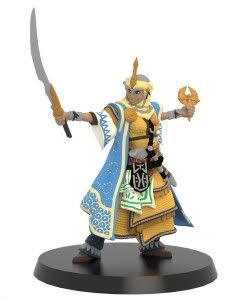
Obviously a cleric (especially if you play pathfinder), but let's reinterpret things a bit.
Tasha Gilder (Fighter/Rogue)
Tasha is a brazen robber and tomb-vulture. That golden symbol? That'll fetch a hefty price once she finds the right collector. Tasha's more of a dungeon-delver than a sneak-thief though (focusing on skills with locks and traps over stealth, hence the heavier armor and bright colors) and even takes a perverse delight in snatching loot from people directly rather than clambering through musty tombs herself. So adventurers would be wise to stay on guard when they emerge with their hard earned haul from deep within forgotten crypts. Tasha might be waiting with a band of expendable thugs to snatch your prize for herself.
Image is from: http://www.purplepawn.com/2011/05/pathfinder-prepainted-plastic/
Tuesday, July 12, 2011
Some art comparison and the first entry in the gallery of rejection
So I've been drawing Beyond Reality now (off and on obviously) for about 8 years and although the progress with the story has tended to falter I've always enjoyed seeing how my ability to draw has evolved. I know many artists are immensely critical of their own work but for some reason the art style I've cobbled together is one I've always enjoyed. Sure I can see it's full of technical flaws and I know there's lots of room for improvement but I seem to be in the rare position of actually being able to enjoy my own art. Of course that's probably just self-delusion considering I thought most of my first drawings were pretty good. Lets take a look:
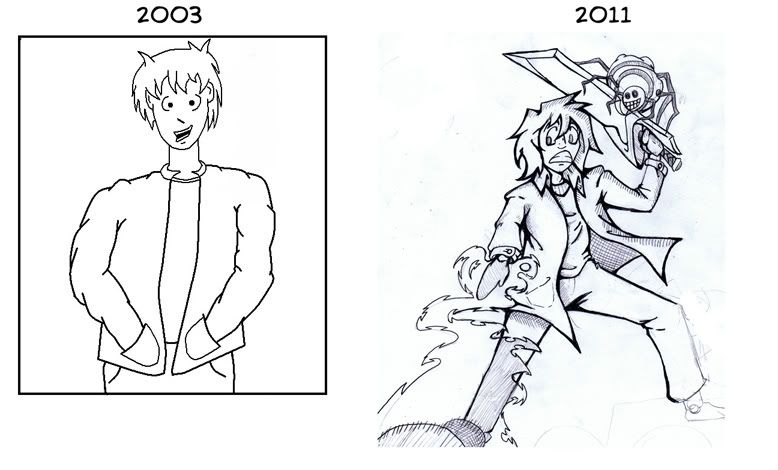
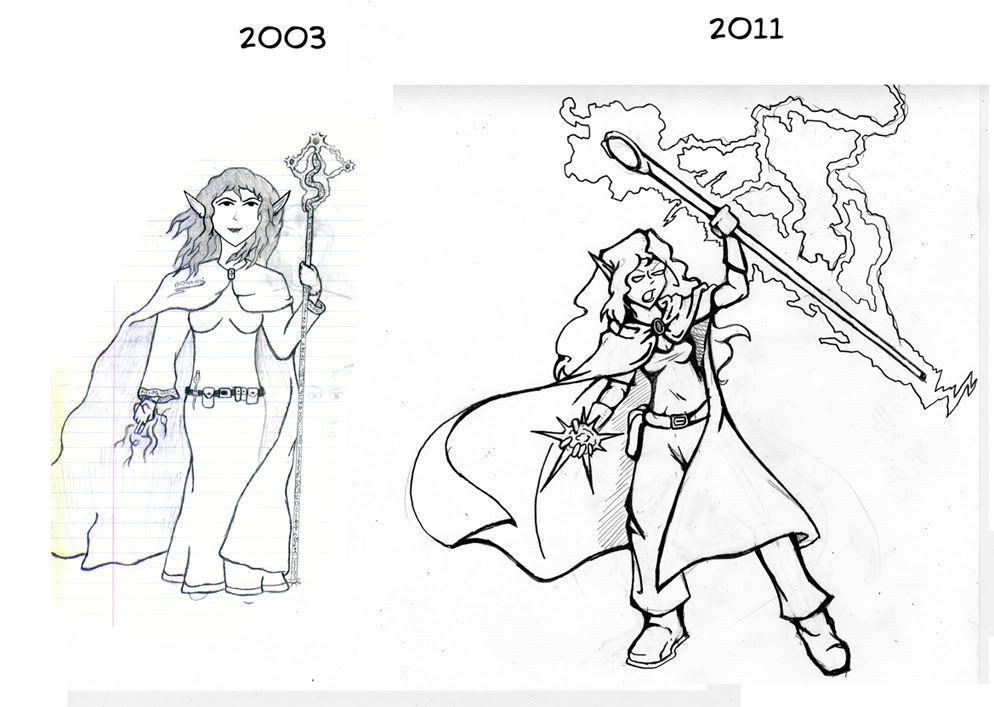
Hopefully eight years from now I can look back on my current art and see that I've improved just as much. Anyway, that's the last old art I'll force on anyone here. Which brings me to my second item:
THE GALLERY OF REJECTION
For the last several years most of my energy has been going into finding and keeping a job that can pay the bills and help me knock a few chips out of my student loans. Fortunately I've recently gotten a new position which has not only better pay but more freedom so I'm left with a lot more energy I can devote to my other interests: attaining internet fame and making a living from my writing. Along with restarting Beyond Reality and creating this blog I've resolved to get involved in more events, contests and schemes to help hone my skills and spread myself around. That way I seem less like a crazy person speaking into the cold, endless void of the internet. Yelling into an endless well of advertisements and pornography.
As part of this I'm creating the Gallery of Rejection showcasing all of my failed attempts and rejected submissions. Please understand this isn't meant to be a place where I gripe about how "I should have won" or complain about those who rejected me. It's the internet and there are thousands and thousands of immensely talented people out there trying to do the same thing, many of them much more talented and deserving of recognition than I am. Rejection is inevitable and I can't deal with it I have no business trying in the first place. Instead this is more of a place where I, and hopefully others, can look back on what I've tried in the past without feeling angsty or discouraged. Some of these entries will be for contests or events with major stakes, others might be nothing more than friendly competitions. In the Gallery, all are equal.
The first item in the Gallery comes from a contest at Piazo publishing called RPG super-star. I entered, along with hundreds of other aspiring RPG writers. The first stage of the competition involves the creation of an original magical item, complete with stats. It's worth noting that as part of the terms of the contest this item does belong to Piazo now. My submission was the Cape of the Night Stalker.
Cape of the Night Stalker
Aura: Moderate Evocation and Transmutation; CL: 11th
Slot: Shoulders; Price: 27,000 gp; Weight: 1 lb.
This lightweight cape is fashioned from pitch-black cloth and has a clasp decorated with obsidian. The cape grants the wearer 60 foot darkvision so long as the cape is worn and also draws upon the power of darkness and shadow to enhance the wearer’s physical and mental abilities. When the wearer is in an area of dim light they receive a +2 enhancement bonus to both Strength and Charisma. In areas of darkness the bonus increases to +4. Treat these as temporary ability bonuses.
Once per day the wearer may speak a command word that causes the cloak to dissolve into an insubstantial fog of pure shadow. This functions as a deeper darkness spell which radiates from the wearer continually until a second command word is spoken, causing the cape to reform around the wearer’s shoulders. While transformed the cloak ceases to grant any other bonuses to the wearer.
Construction
Requirements: Craft Wondrous Items, Deeper Darkness, Darkvision, Bull's Strength, Eagle's Splendor; Cost: 13,500 gp
There you go, the first of many to come. By the way, if anyone knows of any other interesting writing or art contests, especially those related to webcomics or role-playing games feel free to let me know.
Subscribe to:
Posts (Atom)