
Showing posts with label writing. Show all posts
Showing posts with label writing. Show all posts
Friday, July 26, 2019
Badass Kung Fu Demigods Pre-Penultimate Draft Completed
And now we have it completed, the latest draft of Badass Kung Fu Demigods
https://drive.google.com/file/d/1OuOpn0XW6ceYICbis_zFEEVSzLy1dHY6/view?usp=sharing
Still definitely not the final design, but getting closer. Definitely getting closer.


Monday, June 17, 2019
Badass Kung Fu Demigods design journal, pt 3
Fun fact, a few days ago I noticed a persistent scotoma floating around the center of my vision. So, hopefully I'm not going blind...but if I am I better hurry up and get this stuff written out while I still can (I've got an eye exam in a few days, hopefully it won't be something to worry about).
But back on topic, when I was talking about the Core Traits (which I'm pretty sure are going to be reduced to Might, Style, Reflex and Mettle, or some synonyms thereof). [[EDIT: I've settled on Heat (strength), Impulse (speed), Style (skill) and Guts (willpower)]]. I mentioned that I wasn't going to completely get rid of player-defined abilities and that's where Defining Traits come in.
Your Core Traits are the things that are universal, making Defining Traits the personal, customized elements of your character (before getting into crazier stuff like Powers). A Defining Trait is kind of a combination of the previous draft's Backgrounds and Knacks all in one. They're usually meant to be big, broad concepts that cover a lot of ground. Some examples of Defining Traits:
- Giant Robot Disguised As A Teenager
- Machine Shaman And Techromancer
- Renegade Alchemist
- King Of The Moon
By themselves Defining Traits have two very simple functions. First they define your character in a way that establishes permissions (I'll try and come up with a pithier term) allowing a character who is Megacorp Neo-Count to flaunt their wealth, get invitations to social gatherings and have a closetful of gilded codpieces or a character with a Infernal Motorcycle flying on wheels of fire or calling their bike with a whistle.
The second is when one of your Defining Trait is relevant to a roll you're making you get a 1-die bonus to the roll. This isn't cumulative with multiple Defining Traits (so don't worry about stacking all your Traits into combat or anything). So the Neo-Count gets the bonus if he's driving his custom supercharged sportscar or bribing someone with a large stack of cash or intimidating someone with his family's reputation.
This doesn't sound like much, but the main benefits will be related to a brand new mechanic I'm calling the Spotlight mechanic. While Spotlights have other uses (which I'm still tinkering with) one of the primary uses will be to allow you to expend your Spotlight in order to make a Boosted roll related to one of your Defining Traits.
Although I haven't settled on a final decision I'm thinking characters will probably have two or three Defining Traits, enough to cover most any normal starting concept.
Saturday, June 15, 2019
Badass Kung Fu Demigods Design Journal pt 2
So, here we get to the bit of inspiration that ended up sparking the series of ideas leading to this re-write. It's a pretty small change overall, but it opened up a fair number of new doors so I'm quite pleased with it. I hope it doesn't turn out to be secretly broken as hell, because I'd hate to have to ditch it.
The change has to do with how traits are rolled. Like the previous drafts the Traits are rated by a die-type which ranges from d4 to d12. The latest version involved rolling two dice by default and taking the highest result. The change was pretty minor, instead of keeping just the highest, both dice are added together.
So, understandably this might just seem like just throwing around bigger numbers, but it does give me an important additional lever. One of the frustrations of the previous drafts was the inability to fiddle around with the mechanics of the system too much when it comes to powers and abilities. It's one of the downfalls of a rules-light system, and finding a satisfying middle ground was tough.
You see, by keeping two dice I open up a new door: increasing or decreasing the number of dice "kept" on a roll. So an extremely advantageous roll is referred to as Boosted allowing you to roll and keep three dice, while an extremely disadvantageous roll is referred to as Busted and you only get to roll a single dice. To keep things from getting crazy both effects are non-cumulative, your roll can only be Boosted/Busted once and if it is both Boosted and Busted the effects cancel out and you roll normally.
The previous bonus dice rule remains, adding extra dice but still keeping the original number. So a Boosted roll with three bonus dice means you roll six dice and keep three. negative dice are removed...they were never a significant element to be honest and the more dramatic effect of a Busted roll is more useful.
By simply having both the Boost/Bust mechanic and regular bonus die I can now work with a much larger variety of effects. For instance, it becomes a great way to represent the difference between Power Levels...a character with a higher Power Level gets their roll Boosted when acting against someone with a lower Power Level. Busted rolls are a good way to represent a crippling-type Power and Boosting rolls is a good way to represent an exceptional bonus (like a holy-themed power Boosting your rolls against creatures of evil).
This also provides a good way to represent the power of a Champion-class NPC, giving them an extra die, independent of the Boost/Bust system. So a normal roll is 3 dice, a Boosted roll is 4 and a Busted roll is still 2. That alone should make a champion encounter powerful enough to easily challenge an entire team of PCs.
Friday, June 14, 2019
Badass Kung-Fu Demigods Design Journal: Is This Even My Final Form?!
Sometimes the best thing you can do for a project is put it down for a bit and step away, because you'll often find that in a month or two you'll be in the shower and a little idea comes and knocks on the back of your brain to introduce itself, often completely transforming things in the process. This isn't the first time this has happened in BAKFDG and I had one of those weird moments of out-of-the-blue inspiration which sets off a chain of dominoes in your design.
So, with that in mind I'm using this to put down a few of the new ideas and try and get them to gel a bit before I write up an actual new draft.
Core Traits
So, one of the biggest problems I've run into with BAKFDG is trying to make player characters feel distinct from one another. What is truly the difference between a huge burly ham-hock of a brawler and an elegant cyborg duelist with a laser sword?
In the previous draft my attempt to resolve this was with Fighting Forms, giving a mechanical distinction between fighting with brute strength and fighting with speed or skill. While I was fairly satisfied with the rock-paper-scissor system of advantages over different forms, I wasn't particularly thrilled about the other half of the equation (basically giving each Form a bonus Strike when you score two Strikes on a roll). None of them were great, and it always felt like Might would naturally be more desirable overall (bonus damage being significantly more advantageous in most situations). So I've been wracking my brain on how to emphasize these distinctions and was stalled out for a long time.
Getting here involved brutalizing a sacred cow a bit...not quite slaughtering it but definitely giving it a proper maiming. What I'm talking about is the original PDQ-style player-defined Traits, which were already being de-emphasized. At the start of the project Traits were entirely player-defined and there was no real mechanical distinction between different Traits beyond their inherent scope. Eventually I realized the need for more of a mechanical skeleton and divided Traits into general backgrounds and the more defined Fighting Styles. But although they operate within separate realms both still were fairly loose and open.
Which brings us to a new concept: Core Traits. Unlike my previous drafts, Core Traits are more like traditional RPG stats and are each assigned a die-type from d4 to d12. Each character has five Core Traits:
Speed (alternate names: Wind, Flash): Just as it sounds, covers speed, dexterity, agility and fastiness.
Might (alternate name: Mountain, Brute): Also self-explanatory. Being strong and durable.
Skill (alternate names: Ocean, Style): This one's a little more complex, basically anything that requires skill or training or patience. picking a lock or a pocket would fall into this category, along with things like hacking a computer.
Power: (alternate names: Flame, Spark): The ability to project your force of personality, energy or mystical power. This is the trait used for things like throwing energy blasts or giving a rousing speech.
Will: (alternate names: Steel, Mettle): Indomitable spirit and never-give-upedness.
Basically, all actions fall under one of these five traits. If something doesn't fall under the scope of a Core Trait then it's probably not worth rolling (or handled with a special rule that'll come up later). These aren't the only types of Traits, they're combined with Defining Traits which are player-defined abilities that'll be expanded on soon.
One notably important element is that each of the five Core Traits is equally useful for combat. You can fight with your Might, your Speed or your Will or whatever. Some Powers might force or limit Trait choices (a psychic battlefield forces you to use Power or Will for instance) but largely each is equally applicable in combat.
The Rock-Paper-Scissors element will be kept as well. Speed has a bonus against Skill, skill has a bonus against Might, Might has a bonus against Power and Power has a bonus against Speed. Will is an all-rounder and is neither strong nor weak against any other Trait.
Concerns:
Biggest one is that the five-Trait array feels just a tad forced. I'm considering dropping Power which is currently the odd one out in a few ways (mainly in that it kind of assumes everyone has the ability to shoot energy beams and whatnot...not a bad assumption for a game like BAKFDG but not every version fits). Either way I want to keep the Will stat as a all-rounder type, so that'll just collapse the first three into a 3-way RPS set-up.
This is a good example of why you want to avoid getting too attached to a theme. When I was originally setting this up I went with an elemental theme: Wind, Rock, Flame, Ocean and Steel. But this means I was forced to try and make some of these concepts fit thematically in a way that wasn't too natural.Now that I type things out with a more generic name-set instead of the forced elemental theme I feel a lot more confident in changing to a 4-stat array.
Tuesday, May 9, 2017
Badass Kung Fu Demigods: Progress Report
So, you know how it is. You intend to make a blog post talking about the 6th draft of your RPG, but along the way you start working on the seventh draft...and you forgot to actually post anything about the 6th draft.
Well, we're on to the seventh draft, available here: Badass Kung Fu Demigods
Some pretty big changes, unsurprising considering there's been two whole versions since the last BAKFDG post. I'll see if I can summarize some of the most notable ones.
- External Traits are just gone. I realized that they were, ultimately, extraneous and were part of the old style "Exalted Heartbreaker" design of Badass Kung Fu Demigods, attempting to emulate things like artifacts and the like. So all Traits are just Traits now. You want to take a big ol' sword as a Trait, that's fine but in all but the most exceptional cases they're best handled as Knacks.
- Combat (and rolling in general) has evolved with the use of something called Strikes. When you beat an opponent's roll by 5 you earn a Strike (plus one for each additional 5 points). Strikes are flexible bonuses that can be used to inflict damage on opponents, grant a bonus to your next action, inflict a penalty on your opponent's next action or create Declarations. You can earn Strikes on every roll, which means a very good defensive roll can penalize or damage your opponent.
- Speaking of...Declarations are basically the ability to take a bit of narrative control over a situation. That's things like grabbing your opponent, disarm them or set everything on fire. It's an evolution of the "Seizing Control" option from the previous draft.
- Fighting Spirit has evolved, functioning as a general combat bonus (adding to attack and defense) and the bonus increases with the number of opponents you're fighting, the damage you've taken and (optionally) if you're wielding a Deadly Weapon.
- several combat options have been tweaked or simplified and a special option is introduced: Psych Out, which allows you to build up Tension, for your big powers.
- The Mortal power level has been ditched entirely, if you don't qualify as at least Heroic you're only going to be a Weakling at best. Energy has also been increased for the lower Power Levels with Heroic characters getting 2 EP/round and Awakened characters getting 4. An extra Power Level (Monstrous) has been introduced between Awakened and Unleashed power levels.
- interaction with higher-powered opponents is a bit less devastating. A higher level character no longer doubles their roll and instead gets a bonus Strike on any successful roll.
- Powers are no longer limited by Power Level, instead everyone just has access to a selection of Basic Powers, limited only by their Energy. Several of the previous universal powers are now "converted" to Signature Powers or been removed entirely (replaced by things like Declarations).
- Combos have been replaced with a new Signature Power: Trumps (look...I came up with it before November). Trumps are super-moves that give access to a Tension meter which starts at 0 at the beginning of combat and increases by 1 for each round in the fight (although things like Psych Out let you increase it faster). Activating a Trump lets you "cash in" your Tension rating for an equal amount of free Energy that can be used to fuel the Trump.
- More detailed discussion on creating settings and setting the theme for them. A few new mini-settings as well and a few other changes (Against the Darkness is now set in the 80s and features super-powered arthurian knights, and is called Neon Knights, because everyone likes a Black Sabbath reference.)
Sunday, October 23, 2016
Distracting Myself
So, it's been a bit (seems to be a pattern doesn't it?) but fortunately I've still had a fair amount of opportunity to work on my RPG projects.
So as I was working on the 6th (!!!) draft of Badass Kung Fu Demigods (more on that to come) I decided to distract myself with a new draft for my card-based fantasy heartbreaker. So, I present...
So as I was working on the 6th (!!!) draft of Badass Kung Fu Demigods (more on that to come) I decided to distract myself with a new draft for my card-based fantasy heartbreaker. So, I present...
The broad strokes of the game haven't changed from when I last wrote about it, but I've spruced up the layout a bit and tinkered around with the class abilities to try and get a better balance and replacing a few iffy powers.
Other than a few tweaks here and there I also included a very simple treasure system, an expanded list of example magical items and beefed up the bestiary a bit.
All in all it seems pretty close to done. Certainly needs a bit more polish (and just re-reading bits for this post brought a few editing errors to my attention) and I'm currently tinkering with a rough multi-classing system to be included later, but overall it seems fairly solid.
By the way, I should mention that Dungeons and Decks is in desperate need of playtesting. I don't have much opportunity for face-to-face gaming and the card-based nature of the game makes playing online practically impossible. So, if any of you guys happen to give it a shot please, please pass along any feedback to me. I would be thrilled to hear anything, even if it's just a series of swear words and curses on my family's name. Any feedback is welcome.
By the way, I should mention that Dungeons and Decks is in desperate need of playtesting. I don't have much opportunity for face-to-face gaming and the card-based nature of the game makes playing online practically impossible. So, if any of you guys happen to give it a shot please, please pass along any feedback to me. I would be thrilled to hear anything, even if it's just a series of swear words and curses on my family's name. Any feedback is welcome.
Although Badass Kung Fu Demigods is kind of my passion project right now I think Dungeons and Decks will probably be the first RPG I attempt to put up for sale. It's got a familiar premise but a fun gimmick and there's plenty of opportunity for including some fun art, and certainly at least one or two custom card decks are already being planned.
Speaking of art, one bit of good news is that my wife's condition is doing better. She's still far from "cured" but a new medication has allowed her to operate with a lot less pain. As a result she's been stretching her artistic wings a bit, sketching here and there, the first time in a couple of years. Still a long way from being able to resume her comic work or illustrating my games, but it's the first improvement we've seen in quite a while.
Oh, and unrelated news, today is my birthday. So, happy birthday to me I suppose.
Sunday, June 12, 2016
Badass Kung Fu Demigods: The Importance of Playtesting
Been a few months there. Part of the reason for my pause in the discussion of the game is that I've had the chance to run a slow playtest for Badass Kung Fu Demigods. I say slow since it's a play-by-post on a forum so the pace can be glacial, which is not helped by my own problems keeping a steady posting habits due to general overwork and helping out NJ.
Despite the playtest only being the face-to-face equivalent of a few hours it's already obvious that playtesting is very, very important. When I got into the game I expected to find a few rough edges that needed polishing...I didn't expect that I'd find the need for a major rewrite.
But that's what playtesting is for. You can't always see the problems in your own work and it's amazing how much can fly under your radar, problems that seem really obvious in hindsight but go completely unnoticed no matter how many times you read and re-read your work.
The good news is the playtest didn't show that that the system was an utter garbage fire and with some more work there should be a workable game that just needs some extra polish and tinkering.
Despite the still-ongoing nature of the playtest I've already made some significant changes. The first thing I found out was that the Team-Up rules were broken all to hell. They were meant to support the occasional fastball special or power-ranger-esque team move but they turned out much more devastating than expected when a group of 3-4 characters one-shotted an Awakened-level enemy with a single team-up attack without having to Power Up at all. Then later a mere two people teamed up and utterly annihilated about 8 equal-ranked enemies with one attack.
This led to the second realization...additive bonuses in general were pretty broken. Things like External Traits or even basic Knacks and Styles provide a dramatic edge. With the right build it's easy to get massive quantities of bonuses and opponents who can't build up quite that level of bonus just don't stand a chance.
Those were the first, obvious problems. The rest were a little more subtle. Mainly that the combat dynamic needed some work. Fights between characters who can shift across multiple Power Levels could potentially take quite a while and it actually becomes quite difficult for characters to "break off" combat unless both characters involved mutually agree to end the fight...there's little to no official way to say "I want out". Likewise, even without the Team-Up mechanic outnumbered opponents just can't keep up...the relatively small number of EP available means that it quickly becomes very difficult for characters to pay for a solid defense against multiple opponents let alone having enough EP left over to even try and fight back.
So clearly work was needed. Here's the new draft: https://drive.google.com/file/d/0B5dkSHCjlC_3QmRUT3owZVhJRmM/view?usp=sharing
A quick run-down of the major changes:
*No more additive bonuses. Instead its been replaced with a semi-dice-pool system. The default is a roll of 2dX (where X is your Trait Die) but bonuses and penalties add or subtract dice from that roll. No matter what you always keep the highest result and (normally) discard all other results. Knacks and Styles add a +1 die bonus and most special rules (like chewing the scenery, deadly weapons, and teamwork) now just add bonus dice.
*External Traits are not added but instead rolled separately (including bonuses) and the highest result is taken. Since bonus dice apply to both the biggest advantage of an External Trait is that it more or less doubles any bonus dice you receive.
*Normal range rules have been replaced with "Engagements" where characters are locked in battle with one another. To avoid the problems with ganging up I mentioned before I introduced a rule called "Fighting Spirit" where an outnumbered character gets a bonus die for each opponent they're currently Engaged with. Ranged attacks allow you to attack outside of Engagements and there are rules for Breaking Engagements which allows someone to try and break-and-run if fights are getting too intense.
*During character creation rather than buying Knacks, Styles and Signature Moves from the same "pool" of bonus points each characters gets couple of Knacks, a Style and a pair of Signature Moves. It was pointed out that while Signature Moves are a lot of fun Knacks and Styles are more practical but a bit duller and having to make a decision between the two was a bit lame at the start.
Oh, and I added a new micro-setting at the end of the book, which I quite enjoy, called "After J-Day" where players are angels who have rebelled against heaven to defend the people left behind after the rapture takes the chosen and the gates of hell open upon the earth. Post-apocalyptic archangels vs demonic wasteland bikers.
Sunday, March 6, 2016
Badass Kung Fu Demigods: Breaking System News!
So, as I mentioned Badass Kung Fu Demigods is still very much in development and just the other day a new possibility dawned on me. This may be a part of the core rules, an optional rule for a mini-setting or it may turn out to be nothing at all.
This starts (much like Badass Kung Fu Demigods itself) with Exalted. Now, most of you are probably aware that Exalted recently came out with a 3rd edition. I got into Exalted with the first edition and I still consider 1e the most "playable" form of Exalted. It's got a lot of problems but it's still semi-functional and with some work it can be a good bit of fun. 2nd edition turned me off almost from the word go with its tick-based combat system and it ultimately didn't address the real problems of 1st edition.
Now, I'll preface this by saying I haven't bought or read 3rd edition because I just don't have the spare money to plonk down on a game that I'm unlikely to use. However, from reading about it the combat mechanic still seems quite complicated and the setting has lost some of its appeal with the sheer proliferation of Exalted-types. You don't need that many Exalted!!
Anyway, I will say that there is a concept I've read about in 3rd edition which I like in theory, even if I don't have much faith in the practice. The idea is to set up an opponent for a big "finishing move" attack by hitting them with weaker "withering" attacks to build up advantage, then top it off with an actually damaging attack that blasts them into next week.
Now, that's a concept I quite like. In addition to serving as a satisfying way to regulate the flow of combat but it's also a good way to imitate the "source material" of anime or video games where you build up to big final blows. These are also the inspirations for BAKFDG and so I'm interested in this concept as well.
So the question is, how do I adapt it? Here's the current shape of it in my mind. These rules are quite crude and are still subject to extensive modification or complete dismissal.
Momentum: When making an attack you can choose to go for a Damaging Attack or a Momentum Building Attack (think of a better name for this). Damaging Attacks are resolved normally (roll off, if attacker wins they inflict 1 damage, +1 damage per 5 points by which you beat your opponent). Momentum Building Attacks won't inflict damage, instead they give you Momentum Dice, one die per point by which you beat your opponent's roll. Momentum Building Attacks also do not have to be physical assaults, you can use them to put your opponent off balance, give yourself an advantage, smack talk them or otherwise show off.
possible rule: Taking Damage also gives you Momentum Dice, 1 die per point of damage you take. Possibly the option to convert Energy into Momentum.
Momentum Dice are d6's and when you make a Damaging Attack you can choose to unleash your Momentum (think of a cool name for this), rolling all of your momentum dice (all or nothing, you can't divvy them up) and add them to your roll result to get your final total. Of course, you can choose to use Powers as well.
Momentum Dice go away at the end of a Scene if they aren't used.
Example:
Let's take an example scenario, for simplicity's sake we're going with limited Traits and we'll ignore Powers.
*Sarah, with the Traits of Boxing [d10], Fast On Her Feet [d8], Perceptive [d8]
Vs.
*Giant Rock Guy with the Traits of Made of Rocks [d10], Smashing Stuff [d8] and Big And Scary [d8]
Round 1:
Sarah wants to build Momentum, she could just throw some jabs but that'll be opposed by Giant Rock Guy's "Made Of Rocks" Trait which is an even fight. Instead she'll use Fast On Her Feet to play matador a bit and Giant Rock Guy has no relevant Traits in that area.
Sarah rolls and gets a 6, GRG rolls and gets a 5. Sarah gets one Momentum Die.
GRG tries to smash Sarah.
GRG rolls and gets a 6, Sarah rolls and gets a 3. She takes 1 Damage.
Round 2:
Sarah still wants more momentum and so she performs some more acrobatics, leaping on top of GRG's back while he rages about.
Sarah rolls and gets a 5, GRG rolls and gets a 9. No momentum for her.
GRG tries to smash Sarah
GRG rolls and gets a 5, Sarah rolls and also gets a 5, no damage.
Round 3:
Rinse and repeat:
Sarah rolls 10 and GRG gets a 6. That gives her 4 Momentum for a total of 5.
GRG rolls and gets a 14, sarah rolls and gets a 5. That's 2 more damage, Sarah's taken a total of 3.
Round 4:
Sarah's going for one more round of momentum building. She gets a 7, GRG gets a 3, Sarah's momentum is now 9. If this was a video game her "limit break" bar would be flashing.
GRG rolls a 7 and Sarah rolls a 5. That's 4 damage for Sarah now.
Round 5:
Sarah goes for the kill, rolling 2d10 (keep the highest) plus her momentum +9d6! vs the GRG's 2d10 (keep the highest). Lots and lots of rolling gets a total of 45!! GRG rolls and gets a 5. That's a full 9 damage, easily blowing him apart.
So, that example teaches me a few things, but I'm not sure what. One thing I think I may want to do is rule that any Momentum Building Attack will always generate at least 1 point of Momentum, because otherwise you could end up wasting a lot of dice.
Still not sure if this mechanic is going to go anywhere or not, but if you recall from one of my previous posts that I designed Badass Kung-Fu Demigods to incorporate rules I like and one of the things I liked, but couldn't really include was rolling big handfuls of dice, so the possibility of successfully including them in an interesting and appropriate way is very appealing to me.
I'll keep you updated.
This starts (much like Badass Kung Fu Demigods itself) with Exalted. Now, most of you are probably aware that Exalted recently came out with a 3rd edition. I got into Exalted with the first edition and I still consider 1e the most "playable" form of Exalted. It's got a lot of problems but it's still semi-functional and with some work it can be a good bit of fun. 2nd edition turned me off almost from the word go with its tick-based combat system and it ultimately didn't address the real problems of 1st edition.
Now, I'll preface this by saying I haven't bought or read 3rd edition because I just don't have the spare money to plonk down on a game that I'm unlikely to use. However, from reading about it the combat mechanic still seems quite complicated and the setting has lost some of its appeal with the sheer proliferation of Exalted-types. You don't need that many Exalted!!
Anyway, I will say that there is a concept I've read about in 3rd edition which I like in theory, even if I don't have much faith in the practice. The idea is to set up an opponent for a big "finishing move" attack by hitting them with weaker "withering" attacks to build up advantage, then top it off with an actually damaging attack that blasts them into next week.
Now, that's a concept I quite like. In addition to serving as a satisfying way to regulate the flow of combat but it's also a good way to imitate the "source material" of anime or video games where you build up to big final blows. These are also the inspirations for BAKFDG and so I'm interested in this concept as well.
So the question is, how do I adapt it? Here's the current shape of it in my mind. These rules are quite crude and are still subject to extensive modification or complete dismissal.
Momentum: When making an attack you can choose to go for a Damaging Attack or a Momentum Building Attack (think of a better name for this). Damaging Attacks are resolved normally (roll off, if attacker wins they inflict 1 damage, +1 damage per 5 points by which you beat your opponent). Momentum Building Attacks won't inflict damage, instead they give you Momentum Dice, one die per point by which you beat your opponent's roll. Momentum Building Attacks also do not have to be physical assaults, you can use them to put your opponent off balance, give yourself an advantage, smack talk them or otherwise show off.
possible rule: Taking Damage also gives you Momentum Dice, 1 die per point of damage you take. Possibly the option to convert Energy into Momentum.
Momentum Dice are d6's and when you make a Damaging Attack you can choose to unleash your Momentum (think of a cool name for this), rolling all of your momentum dice (all or nothing, you can't divvy them up) and add them to your roll result to get your final total. Of course, you can choose to use Powers as well.
Momentum Dice go away at the end of a Scene if they aren't used.
Example:
Let's take an example scenario, for simplicity's sake we're going with limited Traits and we'll ignore Powers.
*Sarah, with the Traits of Boxing [d10], Fast On Her Feet [d8], Perceptive [d8]
Vs.
*Giant Rock Guy with the Traits of Made of Rocks [d10], Smashing Stuff [d8] and Big And Scary [d8]
Round 1:
Sarah wants to build Momentum, she could just throw some jabs but that'll be opposed by Giant Rock Guy's "Made Of Rocks" Trait which is an even fight. Instead she'll use Fast On Her Feet to play matador a bit and Giant Rock Guy has no relevant Traits in that area.
Sarah rolls and gets a 6, GRG rolls and gets a 5. Sarah gets one Momentum Die.
GRG tries to smash Sarah.
GRG rolls and gets a 6, Sarah rolls and gets a 3. She takes 1 Damage.
Round 2:
Sarah still wants more momentum and so she performs some more acrobatics, leaping on top of GRG's back while he rages about.
Sarah rolls and gets a 5, GRG rolls and gets a 9. No momentum for her.
GRG tries to smash Sarah
GRG rolls and gets a 5, Sarah rolls and also gets a 5, no damage.
Round 3:
Rinse and repeat:
Sarah rolls 10 and GRG gets a 6. That gives her 4 Momentum for a total of 5.
GRG rolls and gets a 14, sarah rolls and gets a 5. That's 2 more damage, Sarah's taken a total of 3.
Round 4:
Sarah's going for one more round of momentum building. She gets a 7, GRG gets a 3, Sarah's momentum is now 9. If this was a video game her "limit break" bar would be flashing.
GRG rolls a 7 and Sarah rolls a 5. That's 4 damage for Sarah now.
Round 5:
Sarah goes for the kill, rolling 2d10 (keep the highest) plus her momentum +9d6! vs the GRG's 2d10 (keep the highest). Lots and lots of rolling gets a total of 45!! GRG rolls and gets a 5. That's a full 9 damage, easily blowing him apart.
So, that example teaches me a few things, but I'm not sure what. One thing I think I may want to do is rule that any Momentum Building Attack will always generate at least 1 point of Momentum, because otherwise you could end up wasting a lot of dice.
Still not sure if this mechanic is going to go anywhere or not, but if you recall from one of my previous posts that I designed Badass Kung-Fu Demigods to incorporate rules I like and one of the things I liked, but couldn't really include was rolling big handfuls of dice, so the possibility of successfully including them in an interesting and appropriate way is very appealing to me.
I'll keep you updated.
Wednesday, March 2, 2016
Badass Kung Fu Demigods, development journal part 3
Been a while but not dead. Just a busy time. I'm still working on baking Christmas presents for family members. That's how behind I am on things.
Part 3: The Actual Rules
Characters in BAKFDG are built on a small set of player-defined Traits, with NPCs built in much the same way. A Trait basically establishes something about the character and gives it a rating, starting at 1d6 and reaching 1d12. Some example Traits are things like "Massive Brute", "Killer Ninja Warrior" and "World's Strongest President". There were a few basic ideas about Traits:
A) There are no weaknesses or negative traits. That is not to say that you can't come up with a character who has flaws or disadvantages...these are just roleplaying elements with no mechanical backing. This is a game about playing crazy and wild superhumans. Who cares if you don't have arms, just grab a sword between your teeth. It doesn't matter if you're ugly, because no one is thinking about your battered face when you throw a manhole cover through an orbital weapons platform.
B) Traits do not "Stack" (with limited exceptions, see below). The highest Trait is the only one that matters in a given situation. Characters don't get a huge number of Traits and this way there's no need to "dogpile" traits and encourages characters to be a bit more diverse. A swordmaster doesn't have to also be massively muscled or hopping about like a bunny rabbit. Instead they can use their other Traits to flesh out other areas.
C) Traits are meant to be broad and focus is provided with Knacks, which are specializations of Traits allowing them to pick small areas which give cumulative bonuses (+2 per knack).
D) The one exception to stacking Traits are "External Traits", special Traits which represent powerful items, special connections or status in society. Unlike Internal Trait, External Traits can be taken away, denied or simply inaccessible. However, in exchange they provide a powerful boost when using a synergistic Internal Trait.
Originally, the intent was that when faced with a challenge, everyone rolls their Trait. Have a Trait like "World's Strongest President [1d10]" and you need to break something or lift something to impress congress? Roll 1d10 (and if the roll comes up 10 keep rolling and keep adding up the rolls) and see if you succeed. However, it quickly became apparent that this was just too random. It's no good being the World's Strongest President (and yes, I think I will use this guy as my example character from now on) if you keep tossing a bunch of 1's and 3's in a row.
In order to decreases the whiff factor and push number higher I switched to rolling two dice and taking the highest result. So far, this has smoothed things out pretty well.
---------------------------------------------------------------------
Next came how to handle accomplishing tasks. Honestly, I had a little bit of trouble here because I couldn't figure out a good way to calculate target numbers is a smooth, elegant way. Fortunately, I eventually came to a better way, instead of set target numbers any task is simply assigned a die-type and the GM rolls off with the player and sees who gets the higher result. The term I came up with for this was "Opposing Forces" which could cover anything from obstacles, complexity or even a time limit.
Now, this does mean that even the lowest-ranked Opposing Force is capable (if not necessarily likely) to overcome a character with a d10 or d12. But on reflection, I'm fine with this. First, unlike Opposing Forces, characters have access to Powers which can dramatically tilt their odds if they're willing to spend the Energy. Secondly, anything that counts as an Opposing Force against a Badass Kung Fu Demigod should be pretty impressive to begin with. The World's Strongest President doesn't need to roll to break a window or snap a baseball bat over his knee...he should be rolling for ripping chains from walls or (at higher Power Levels), toppling the Washington monument.
---------------------------------------------------------------------
Then there's fighting each other!
Clashes are BAKFDG's term for general conflicts. They largely include fighting, but it'll also include social, mental or physical challenges outside of combat. Clashes are resolved by taking turns rolling off using whatever appropriate Trait's you're using for attacks or defenses. If the attacker wins they inflict a point of damage, if the beat the opponent by 5 or more then you inflict an additional point of damage (which continues for each 5 additional points of damage). Taking a total of 5 damage takes you out of the fight.
This is one area where I compromised in a way that I feel made things very slightly worse. The original rules were that each "doubling" of your opponent's result adds an extra point of damage. So if the World's Strongest President punches an alien tripod and the alien rolls a 6 then the President would inflict a point of damage if he rolls a 7 or higher. A 12 or higher would get him two points of damage, a 24 would get him 3 and so on.
Now, this met my goals in some very specific ways. I wanted to avoid the two extremes that seem endemic to high-powered RPGs: "rocket tag" fights or "cherry tapping". The first is when you have enemies with such a high offensive ability that most fights end with the first hit (or the first hit cripples the opponent so badly that the second will surely end them). The second is when characters have so many hit points or such a strong defense that fights drag on forever as you slowly chip away at each other's health.
My goal was to create a system where actually inflicting damage against an opponent isn't too tough and most fights will end within about 3-5 hits, which I felt was not so short as to be unsatisfying and not so long it stops feeling intense. Enough times for tables to turn, allies to show up or a bit of banter to be traded.
However, at the same time I wanted the ability for a really powerful or lucky hit to potentially take out an opponent in a single blow. Not a likely event, but something that would be possible (especially when a stronger foe faces a weaker one).
That was the intent behind the doubling mechanic, it ensured that the odds of inflicting extra damage increased non-linearly, requiring more and more luck to get a really strong hit in. I felt it was an elegant damage system that met my needs but unfortunately it didn't quite work out.
I went to the 1 damage per 5 points of difference system because the doubling system, while useful, seemed to cause some calculation issues in play, and more significantly was awkward to explain in the text. Although I still don't feel too content with the change I think it'll turn out to be the right decision and did allow me to create the Deadly Weapons rule.
You see, I realized something working on several of the "micro-settings" for BAKFDGs. Specifically a setting called "Against The Darkness", kind of a hybrid of Highlander and Men In Black where players take the role of immortal enforcers who defend humanity from the hordes of secret monsters that lurk in the night. It was very much intended to be in the Katana-and-Trenchcoat style of Highlander and WoD games like Vampire. But I realized that since I didn't include any rules for weapons outside of External Traits I was actively discouraging players from using them. After all, in a modern setting where players are trying to avoid notice it's quite a pain to lug around guns or katanas and avoid suspicion. And that's not what I wanted, I wanted to encourage rooftop swordfights, or mowing down hordes of were-vampires with twin Uzis firing silver bullets, in addition to unarmed high flying combat.
So I needed a solution and that was the (optional) Deadly Weapons rule. I felt like just adding a flat bonus to your roll was bonus uninteresting and it was difficult to define the line between a piddly bonus not worth bothering with or a bonus that became too big and made the weapon indispensable and rendered unarmed combat worthless. Basically the Deadly Weapons rule lowered the threshold for additional damage from an attack to 1 Damage/5 points to 1 Damage/4 points. This meant that both unarmed fighters and swordsmen have the same minimum damage and largely operate the same, but the weapon gives just enough of an edge to make it worthwhile to carry around. It also only works in the new damage system so I feel it kind of evens out with the original rules.
------------------------------------------------------
I didn't want BAKFDGs to be nothing more than trading blows back and forth and I was hoping to give it a little bit of tactical oomph, so I also came up with a few other rules that I think are interesting...but may or may not be good. Time (and playtesting) will tell.
*Combat Forms: As I mentioned, BAKFDG was born from Battle Royale and one thing that Battle Royale had that the first drafts of BAKFDG didn't was a good way to distinguish between different "flavors" of fighting. In Battle Royale a big brute had a different style from a judo master or an acrobatic knife-fighter. In BAKFDG, different Traits may or may not apply in certain circumstances, but largely one combat-suitable Trait is much like any other. Combat Forms were my attempts to remedy it and to play around with the 2dX mechanic. For instance, the Brute Form was meant to have the ability to hit really hard with a lucky blow, so if both of your Trait dice come out higher than your opponent's highest die result then you can add them both together to get the final total (and thus do more damage). The inverse was the Speedy fighter who doesn't do more damage, but is more likely to hurt the opponent: if you fail an attack but your lowest die result was higher than your opponents lowest dice result you still inflict 1 point of damage anyway.
*Seizing Control: When fighting an opponent and you inflict damage you can choose to reduce the damage by one point in exchange for declaring some kind of advantage you've got over your foe: knocking them off something, disarming them or catching them in a grapple. Essentially meant to prevent them from using one or more of their Traits (such as pinning down a fast or agile opponent, disarming a powerful sword-fighter, etc).
*Chewing the Scenery: basically meant to encourage mass destruction and chaos. By destroying a large part of the environment in a suitably dramatic way (knocking someone into a propane tanker, collapsing a building on them, etc) you can use the Scene as a kind of one-shot External Trait, adding 1d4 to your roll total.
-----------------------
That more or less does it for rambling about the rules, at least the general rules. Next (hopefully not in a month's time!) we'll tackle the main draw of being a BAKFDG: Powering Up!
Part 3: The Actual Rules
Characters in BAKFDG are built on a small set of player-defined Traits, with NPCs built in much the same way. A Trait basically establishes something about the character and gives it a rating, starting at 1d6 and reaching 1d12. Some example Traits are things like "Massive Brute", "Killer Ninja Warrior" and "World's Strongest President". There were a few basic ideas about Traits:
A) There are no weaknesses or negative traits. That is not to say that you can't come up with a character who has flaws or disadvantages...these are just roleplaying elements with no mechanical backing. This is a game about playing crazy and wild superhumans. Who cares if you don't have arms, just grab a sword between your teeth. It doesn't matter if you're ugly, because no one is thinking about your battered face when you throw a manhole cover through an orbital weapons platform.
B) Traits do not "Stack" (with limited exceptions, see below). The highest Trait is the only one that matters in a given situation. Characters don't get a huge number of Traits and this way there's no need to "dogpile" traits and encourages characters to be a bit more diverse. A swordmaster doesn't have to also be massively muscled or hopping about like a bunny rabbit. Instead they can use their other Traits to flesh out other areas.
C) Traits are meant to be broad and focus is provided with Knacks, which are specializations of Traits allowing them to pick small areas which give cumulative bonuses (+2 per knack).
D) The one exception to stacking Traits are "External Traits", special Traits which represent powerful items, special connections or status in society. Unlike Internal Trait, External Traits can be taken away, denied or simply inaccessible. However, in exchange they provide a powerful boost when using a synergistic Internal Trait.
Originally, the intent was that when faced with a challenge, everyone rolls their Trait. Have a Trait like "World's Strongest President [1d10]" and you need to break something or lift something to impress congress? Roll 1d10 (and if the roll comes up 10 keep rolling and keep adding up the rolls) and see if you succeed. However, it quickly became apparent that this was just too random. It's no good being the World's Strongest President (and yes, I think I will use this guy as my example character from now on) if you keep tossing a bunch of 1's and 3's in a row.
In order to decreases the whiff factor and push number higher I switched to rolling two dice and taking the highest result. So far, this has smoothed things out pretty well.
---------------------------------------------------------------------
Next came how to handle accomplishing tasks. Honestly, I had a little bit of trouble here because I couldn't figure out a good way to calculate target numbers is a smooth, elegant way. Fortunately, I eventually came to a better way, instead of set target numbers any task is simply assigned a die-type and the GM rolls off with the player and sees who gets the higher result. The term I came up with for this was "Opposing Forces" which could cover anything from obstacles, complexity or even a time limit.
Now, this does mean that even the lowest-ranked Opposing Force is capable (if not necessarily likely) to overcome a character with a d10 or d12. But on reflection, I'm fine with this. First, unlike Opposing Forces, characters have access to Powers which can dramatically tilt their odds if they're willing to spend the Energy. Secondly, anything that counts as an Opposing Force against a Badass Kung Fu Demigod should be pretty impressive to begin with. The World's Strongest President doesn't need to roll to break a window or snap a baseball bat over his knee...he should be rolling for ripping chains from walls or (at higher Power Levels), toppling the Washington monument.
---------------------------------------------------------------------
Then there's fighting each other!
Clashes are BAKFDG's term for general conflicts. They largely include fighting, but it'll also include social, mental or physical challenges outside of combat. Clashes are resolved by taking turns rolling off using whatever appropriate Trait's you're using for attacks or defenses. If the attacker wins they inflict a point of damage, if the beat the opponent by 5 or more then you inflict an additional point of damage (which continues for each 5 additional points of damage). Taking a total of 5 damage takes you out of the fight.
This is one area where I compromised in a way that I feel made things very slightly worse. The original rules were that each "doubling" of your opponent's result adds an extra point of damage. So if the World's Strongest President punches an alien tripod and the alien rolls a 6 then the President would inflict a point of damage if he rolls a 7 or higher. A 12 or higher would get him two points of damage, a 24 would get him 3 and so on.
Now, this met my goals in some very specific ways. I wanted to avoid the two extremes that seem endemic to high-powered RPGs: "rocket tag" fights or "cherry tapping". The first is when you have enemies with such a high offensive ability that most fights end with the first hit (or the first hit cripples the opponent so badly that the second will surely end them). The second is when characters have so many hit points or such a strong defense that fights drag on forever as you slowly chip away at each other's health.
My goal was to create a system where actually inflicting damage against an opponent isn't too tough and most fights will end within about 3-5 hits, which I felt was not so short as to be unsatisfying and not so long it stops feeling intense. Enough times for tables to turn, allies to show up or a bit of banter to be traded.
However, at the same time I wanted the ability for a really powerful or lucky hit to potentially take out an opponent in a single blow. Not a likely event, but something that would be possible (especially when a stronger foe faces a weaker one).
That was the intent behind the doubling mechanic, it ensured that the odds of inflicting extra damage increased non-linearly, requiring more and more luck to get a really strong hit in. I felt it was an elegant damage system that met my needs but unfortunately it didn't quite work out.
I went to the 1 damage per 5 points of difference system because the doubling system, while useful, seemed to cause some calculation issues in play, and more significantly was awkward to explain in the text. Although I still don't feel too content with the change I think it'll turn out to be the right decision and did allow me to create the Deadly Weapons rule.
You see, I realized something working on several of the "micro-settings" for BAKFDGs. Specifically a setting called "Against The Darkness", kind of a hybrid of Highlander and Men In Black where players take the role of immortal enforcers who defend humanity from the hordes of secret monsters that lurk in the night. It was very much intended to be in the Katana-and-Trenchcoat style of Highlander and WoD games like Vampire. But I realized that since I didn't include any rules for weapons outside of External Traits I was actively discouraging players from using them. After all, in a modern setting where players are trying to avoid notice it's quite a pain to lug around guns or katanas and avoid suspicion. And that's not what I wanted, I wanted to encourage rooftop swordfights, or mowing down hordes of were-vampires with twin Uzis firing silver bullets, in addition to unarmed high flying combat.
So I needed a solution and that was the (optional) Deadly Weapons rule. I felt like just adding a flat bonus to your roll was bonus uninteresting and it was difficult to define the line between a piddly bonus not worth bothering with or a bonus that became too big and made the weapon indispensable and rendered unarmed combat worthless. Basically the Deadly Weapons rule lowered the threshold for additional damage from an attack to 1 Damage/5 points to 1 Damage/4 points. This meant that both unarmed fighters and swordsmen have the same minimum damage and largely operate the same, but the weapon gives just enough of an edge to make it worthwhile to carry around. It also only works in the new damage system so I feel it kind of evens out with the original rules.
------------------------------------------------------
I didn't want BAKFDGs to be nothing more than trading blows back and forth and I was hoping to give it a little bit of tactical oomph, so I also came up with a few other rules that I think are interesting...but may or may not be good. Time (and playtesting) will tell.
*Combat Forms: As I mentioned, BAKFDG was born from Battle Royale and one thing that Battle Royale had that the first drafts of BAKFDG didn't was a good way to distinguish between different "flavors" of fighting. In Battle Royale a big brute had a different style from a judo master or an acrobatic knife-fighter. In BAKFDG, different Traits may or may not apply in certain circumstances, but largely one combat-suitable Trait is much like any other. Combat Forms were my attempts to remedy it and to play around with the 2dX mechanic. For instance, the Brute Form was meant to have the ability to hit really hard with a lucky blow, so if both of your Trait dice come out higher than your opponent's highest die result then you can add them both together to get the final total (and thus do more damage). The inverse was the Speedy fighter who doesn't do more damage, but is more likely to hurt the opponent: if you fail an attack but your lowest die result was higher than your opponents lowest dice result you still inflict 1 point of damage anyway.
*Seizing Control: When fighting an opponent and you inflict damage you can choose to reduce the damage by one point in exchange for declaring some kind of advantage you've got over your foe: knocking them off something, disarming them or catching them in a grapple. Essentially meant to prevent them from using one or more of their Traits (such as pinning down a fast or agile opponent, disarming a powerful sword-fighter, etc).
*Chewing the Scenery: basically meant to encourage mass destruction and chaos. By destroying a large part of the environment in a suitably dramatic way (knocking someone into a propane tanker, collapsing a building on them, etc) you can use the Scene as a kind of one-shot External Trait, adding 1d4 to your roll total.
-----------------------
That more or less does it for rambling about the rules, at least the general rules. Next (hopefully not in a month's time!) we'll tackle the main draw of being a BAKFDG: Powering Up!
Tuesday, July 12, 2011
Some art comparison and the first entry in the gallery of rejection
So I've been drawing Beyond Reality now (off and on obviously) for about 8 years and although the progress with the story has tended to falter I've always enjoyed seeing how my ability to draw has evolved. I know many artists are immensely critical of their own work but for some reason the art style I've cobbled together is one I've always enjoyed. Sure I can see it's full of technical flaws and I know there's lots of room for improvement but I seem to be in the rare position of actually being able to enjoy my own art. Of course that's probably just self-delusion considering I thought most of my first drawings were pretty good. Lets take a look:
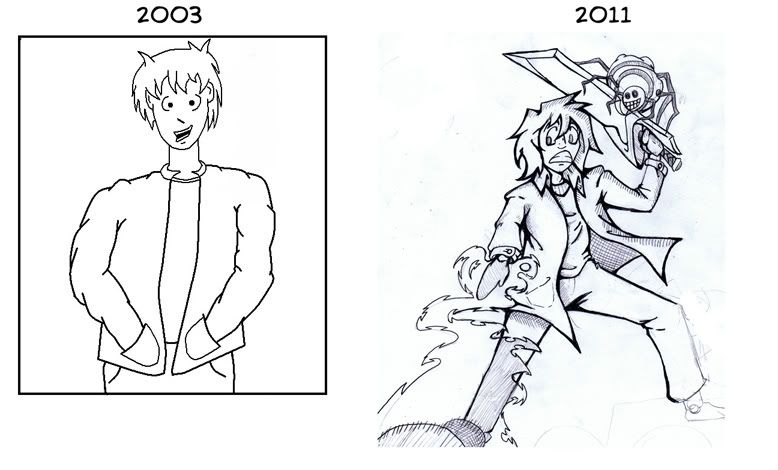
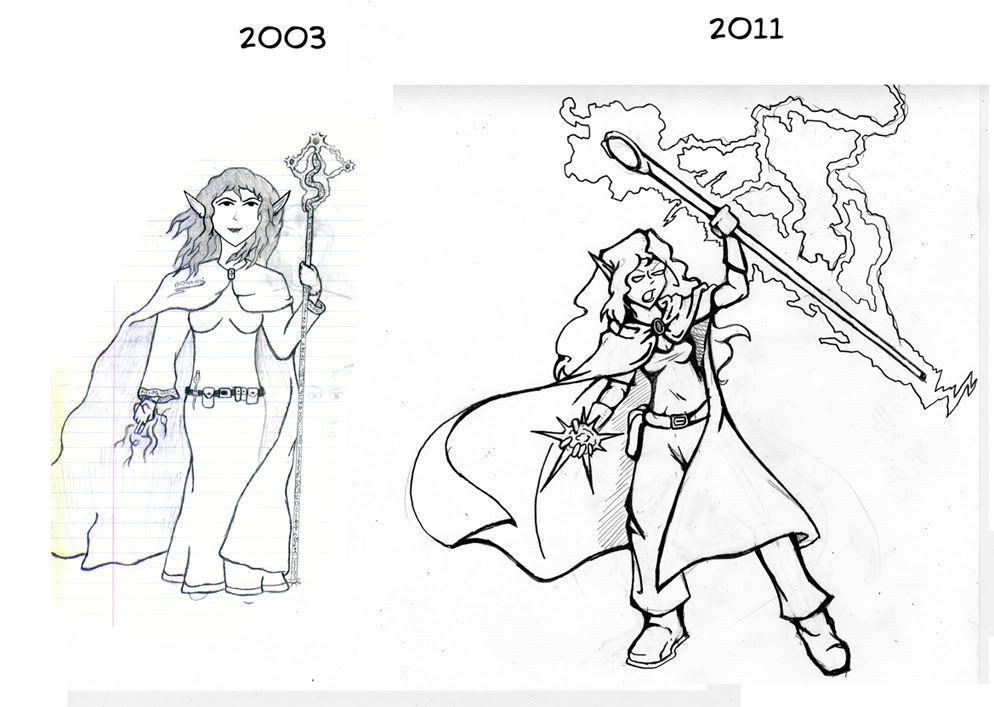
Hopefully eight years from now I can look back on my current art and see that I've improved just as much. Anyway, that's the last old art I'll force on anyone here. Which brings me to my second item:
THE GALLERY OF REJECTION
For the last several years most of my energy has been going into finding and keeping a job that can pay the bills and help me knock a few chips out of my student loans. Fortunately I've recently gotten a new position which has not only better pay but more freedom so I'm left with a lot more energy I can devote to my other interests: attaining internet fame and making a living from my writing. Along with restarting Beyond Reality and creating this blog I've resolved to get involved in more events, contests and schemes to help hone my skills and spread myself around. That way I seem less like a crazy person speaking into the cold, endless void of the internet. Yelling into an endless well of advertisements and pornography.
As part of this I'm creating the Gallery of Rejection showcasing all of my failed attempts and rejected submissions. Please understand this isn't meant to be a place where I gripe about how "I should have won" or complain about those who rejected me. It's the internet and there are thousands and thousands of immensely talented people out there trying to do the same thing, many of them much more talented and deserving of recognition than I am. Rejection is inevitable and I can't deal with it I have no business trying in the first place. Instead this is more of a place where I, and hopefully others, can look back on what I've tried in the past without feeling angsty or discouraged. Some of these entries will be for contests or events with major stakes, others might be nothing more than friendly competitions. In the Gallery, all are equal.
The first item in the Gallery comes from a contest at Piazo publishing called RPG super-star. I entered, along with hundreds of other aspiring RPG writers. The first stage of the competition involves the creation of an original magical item, complete with stats. It's worth noting that as part of the terms of the contest this item does belong to Piazo now. My submission was the Cape of the Night Stalker.
Cape of the Night Stalker
Aura: Moderate Evocation and Transmutation; CL: 11th
Slot: Shoulders; Price: 27,000 gp; Weight: 1 lb.
This lightweight cape is fashioned from pitch-black cloth and has a clasp decorated with obsidian. The cape grants the wearer 60 foot darkvision so long as the cape is worn and also draws upon the power of darkness and shadow to enhance the wearer’s physical and mental abilities. When the wearer is in an area of dim light they receive a +2 enhancement bonus to both Strength and Charisma. In areas of darkness the bonus increases to +4. Treat these as temporary ability bonuses.
Once per day the wearer may speak a command word that causes the cloak to dissolve into an insubstantial fog of pure shadow. This functions as a deeper darkness spell which radiates from the wearer continually until a second command word is spoken, causing the cape to reform around the wearer’s shoulders. While transformed the cloak ceases to grant any other bonuses to the wearer.
Construction
Requirements: Craft Wondrous Items, Deeper Darkness, Darkvision, Bull's Strength, Eagle's Splendor; Cost: 13,500 gp
There you go, the first of many to come. By the way, if anyone knows of any other interesting writing or art contests, especially those related to webcomics or role-playing games feel free to let me know.
Subscribe to:
Posts (Atom)